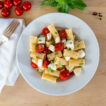
Alla salute!

Italian food, we were once told, is the most unhealthy of all ethnic food in the U.S..  Worse than Asian food, worse than Mexican food.  Sadly, in America and other countries outside of Italy, it is true.  Italian food has become synonymous with pasta, cheese, tomatoes and meat.  When we think Italian, we think heavy meals of gigantic portions, and rich desserts.

Insalata mozzarella, tonno e pomodoroAt a recent party, the hostess, holding a plate full of catered Italian-American food and talking to us about Due Spaghetti, asked us how we manage eat Italian and yet stay so thin.  We didn’t know how to answer her.  “This isn’t Italian food.” would not have been polite, despite being true.  We were actually eating Italian-American food.  The difference is substantial.  While Italian cuisine certainly includes some rich dishes, authentic Italian food, especially that originating from the southern Italian regions, is among the world’s healthiest.

Insalata mozzarella, tonno e pomodoroThe much-acclaimed Mediterranean diet was inspired by the culinary traditions of Southern Italy, Spain, Greece and Morocco, where olive oil, vegetables, fruit, legumes, and whole grains serve as the foundation of people’s diet.  Fish and seafood is also a staple of the Mediterranean diet. Consumption of dairy products (mostly as cheese and yogurt), and wine is moderate, while meat and meat products are rare.

In Italy meals are balanced.  A carb-based first course of pasta or rice is followed by a protein-based second course of fish, eggs, or lean meat.  Consumption of red meat is infrequent, portions are small, vegetables are abundant, and dessert is a simple fresh fruit.  Where that diet still prevails, people boast among the highest longevity and the lowest disease rates in the world.  It is a far cry from the Italian-American fare that has become known around the globe as Italian cuisine.

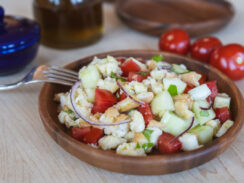
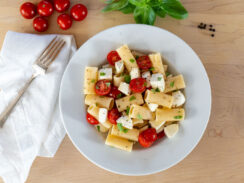
In the warm summer months, meals are often light and simple in Italy.  The piatto unico, or single course meal, is increasingly common for lunch and sometimes for dinner.  One of our favorites is a refreshing summer salad made of lattuga (romaine), fresh corn, tuna, mozzarella and tomatoes.  It is light, yet filling enough to make a meal of.

Insalata mozzarella, tonno e pomodoroDSC_0077

Ingredients
(quantities are all as desired)

Hearts of Romaine
Canned whole kernel corn
Fresh mozzarella
Tuna, in olive oil
Roma tomatoes
Salt
Ground pepper
Olive oil

Directions
Chop the romaine, tomatoes, and mozzarella into bite-sized pieces, and place into a salad bowl.  Drain the olive oil off of a can or more of tuna, and add it to the salad.  Add sea salt, ground black pepper and a few tablespoons of extra virgin olive oil if desired.  Toss, and enjoy.

oInsalata mozzarella, tonno e pomodoroDSC_0074

Posted in Recipes and Wine Pairings, Vegetables and Salads | Tagged , | 3 Comments

Supplì al telefono

We’ve had this recipe and accompanying photos ready for a week now, but the time and more importantly the inspiration to write a post around them have been missing.

Supplì al telefono

It arrived last night in the form of an 11-month-old bundle of smiles, curiosity and drool named Penelope.  She was our guest at dinner, along with her parents Veronica and Lauren, and our mutual friends Emily and Ben.  It was a brilliant evening to benefit the amazing students and teachers at Cara’s school, with a menu of some of our favorite seafood dishes:

Antipasto misto di pesce (Mixed seafood appetizers)
Riondo Prosecco
Pennette al salmone (Pennette in a creamy salmon sauce)

Lageder Pinot Nero
Pesce spada al cartoccio (Baked Swordfish with seafood)

Falanghina Terredora
Insalata mista (Baby Salad Greens)
Tiramisù al limoncello (Limoncello Tiramisù)

Limoncello
Caffè e Digestivi (Espresso and Digestif)

But, back to Penelope.  She was busy and happy.  She explored the living room, engaged playfully with the adults, and snacked on food from her own little portable, spill-proof bowl. Her parents took turns holding her, and before any of us realized it, 5 hours had passed.

It reminded us of when our oldest, Sean, was a baby.  We still lived in Rome then, and didn’t think twice about bringing him out with us where ever we went.  He was content to observe the world from his stroller or ride along in the baby carrier worn by his mamma or papà.

Some of our favorite spots to take him were Campo de’ Fiori, where we could content him with a piece of pizza rossa, the hill-town of Frascati in the Castelli Romani, or the village of Nemi, perched high above the volcanic lake Lago di Nemi, just south of Rome.  Nemi is famous for its berries, frutti di bosco, and especially the miniature wild strawberries that are bursting with flavor.  In summertime, it was a cool reprieve from the heat of Rome.  We’d take a stroll through Nemi’s narrow streets, stopping for a gelato alla crema with berries on top.  We’d bring along a banana and some Biscotti Plasmon, Italy’s quintessential baby biscuits, and ask the barman to add milk and blend up a smoothie for Sean.

Closer to home, Pizzeria Pizza & Fichi, at Via Alenda, 26 in Rome’s Giardinetti neighborhood was a favorite spot for Roman-style pizzas, filetti di baccalà and supplì, made by our friends Fabrizio, Massimo, Carmela and their mom at the family business.  We’d choose an outdoor table underneath a broad umbrella, order our pizzas, and feed Sean while we waited for our food.  Like clockwork, he would fall asleep by the time our pizza arrived.  We’d recline his stroller seat, place him back into it, and enjoy our pizza while he slept.

Supplì al telefono are a rice croquette fritter found on the antipasti menu in pizzerie all across the city.  The rice is cooked with a bit of tomato sauce, sometimes with ground beef, and let to cool.  Then, it is molded into an egg-like shape, and a piece of mozzarella is pushed into the middle of it before it is breaded and fried.  When the supplì is broken open, the melted mozzarella stretches from one piece to another, resembling the cord on an old-fashioned telephone.

Ingredients
for 8 supplì

500 grams Arborio, Vialone Nano or Carnaroli rice
1 large can of whole tomatoes (500 grams or 28 0z)
Ground beef, approximately 250 grams or 1/2 lb.
Onion
Olive oil
Salt
Fresh mozzarella
4 eggs
Breadcrumbs
Flour
Vegetable, peanut or olive oil for frying

Directions
Prepare the sauce by dicing 1/4 of a small-medium onion, and sautéing in olive oil over medium heat.  Add the ground beef and brown it slowly, using a spatula to crumble the meat finely.  Add the tomatoes, passing them through a food mill.  Add a splash of water or red wine if too thick, and allow it to simmer for at least 45 minutes.  Salt to taste.

Cook the rice in abundant boiling water with a handful of salt tossed in, just as you would cook pasta, according to the cooking time on the package.  When the rice is done, drain off the water using a strainer.  Add the rice to the sauce and stir well until it is evenly coated.  Place onto a baking tray or into a large baking dish and spread it out in order to facilitate cooling.

Once the rice is cool, you are ready to assemble and fry the supplì.  Add your oil several inches deep into a pan suitable for frying, and place it over medium heat.

Supplì al telfono

Fill a dish with flour, another with breadcrumbs, and a final one with the eggs, which you will beat slightly.  Cut 8 small pieces of mozzarella to stuff inside the supplì.

Wet you hands to make it easier to handle the rice.  With your hands, scoop enough rice to make an egg-sized supplì.  Mold it into an oblong shape, and using your thumb make an indent in the center.  Fill the indent with a piece of mozzarella, and then enclose the mozzarella with rice so that it is tucked well inside.

Supplì al telefono

Dust the supplì in flour, dip it into the egg and rotate it so that it is well-coated, and then finally roll it in the breadcrumbs.  Some recipes suggest repeating a second coating of egg and breadcrumbs.  We tried it both ways and preferred a single layer, but you may wish to experiment and decide which option works best for you.

Supplì al telefonoSupplì al telefono

Gently place each supplì into the hot oil and fry until it takes on a rich brown hue.  Remove from the oil and set on absorbent paper towels.  Allow to cool slightly, and enjoy with a Birra Moretti.

Supplì al telefono

Posted in Appetizers, Pasta, Rice and Grains, Recipes and Wine Pairings | Tagged , , , | 12 Comments

Costolette di abbacchio alla scottadito

Easter food is so good that we’ve been celebrating all week long!

Costolette di abbaccio a scottaditto

The subject of tonight’s meal, costolette di abbacchio alla scottadito, is a storied Roman dish that is savored on Pasqua or Pasquetta, and throughout the year. But before we tell that story let’s take time for an Italian lesson, because it will all make much more sense then.

Costolette is a culinary term that means “chops” as in pork chops, lamb chops, etc.  It comes from the noun costola (singular) and costole (plural) which mean ribs – an anatomical term to describe this human and animal body part.  The diminutive suffix -etta, which indicates smallness, in this case distinguishes costoletta (singular) or costolette (plural) as the cooked meat that we eat – i.e. chops.

Abbacchio means suckling lamb.  This is not a common concept in many nations, so bear with us.  Agnello is the Italian word for lamb, and in fact there are many recipes for agnello.  However, abbacchio is something special, especially in Rome.  An abbacchio is a young lamb that has only been nourished with its mother’s milk when it is butchered.  The young lamb usually weighs 4-6 kilos and is just over one month old.

The etymology of the word abbacchio is curious – some have traced it to the Latin expression ad baculum, which means “near the stick” which may represent the stick to which the mother lamb was tied, or which may represent the stick that in ancient times was used to butcher the lamb.  Even today, the slang term abbacchiato is present in Roman dialect, meaning “beaten down.”

Finally, scottadito is a descriptor made up of two Italian words: scotta, and ditoScotta means “hot,” or “scalding.” Dito means “finger.” So, put together, scottadito means “finger-scalding.”  These chops are to be eaten with your hands, while the protruding rib bones are still so hot that they burn your fingers.

So, costolette di abbacchio alla scottadito.  Finger-scalding suckling lamb chops.  It sounds better in Italian, doesn’t it?

Whatever language you name it with, costolette di abbacchio alla scottadito is delicious – the gamey flavor of lamb is tempered by a rub of rosemary, sage and garlic.  It can be grilled, or pan-seared, as we prepared it.  To be truly traditional, serve them with oven-roasted potatoes.

Ingredients
One rack of lamb chops.  If you can find suckling lamb, this is ideal.  If not, lamb chops will work.
Rosemary
Sage
Garlic
Olive oil
Fingerling or Yukon Gold potatoes
Salt
Crushed red pepper (optional)

Costolette di abbacchio alla scottadito

Directions

Carefully cut the rack of lamb into separate chops.  We also chose to trim the excess fat, but that is a matter of preference.  Mince the needles from a few sprigs of rosemary, the leaves from a small bunch of sage, and a few cloves of garlic.  Spread the chops onto a baking sheet, drizzle olive oil over both sides of them, rub the herbs onto the meat, and salt to taste.  Add crushed pepper if you like a little heat. Splash them with some dry red wine, and let rest.

Costolette di abbacchio alla scottaditoCostolette di abbacchio alla scottadito

In the meanwhile, heat the oven to 350° F / 180° C.  Peel your potatoes and cut them into small pieces.  If you are using fingerling potatoes, simply scrub them and leave whole with the skin on.  Place the potatoes into a baking dish, drizzle them with olive oil, add the needles from one sprig of rosemary, and salt well.  Bake for 30-45 minutes, stirring them occasionally, until the potatoes are cooked inside and crispy on the outside.

Roasted Potatoes

While the potatoes are baking, return to the lamb chops.  Either grill the chops, or heat a few tablespoons of olive oil in a skillet and sear them for a few minutes on each side.  If you use a skillet, be sure to preserve all of the oil, wine and herbs from the marinade.

Costolette di abbacchio alla scottaditoCostolette di abbacchio alla scottadito

Serve the costolette finger-burning hot, with the roasted potatoes on the side.

Costolette di abbacchio alla scottadito

Posted in Meat, Fish and Legumes, Recipes and Wine Pairings | Tagged , | 4 Comments

Torta Pasqualina

Pasqua con i tuoi, Pasquetta con chi vuoi.

Torta Pasqualina

Easter, the saying goes, should be spent with family.  Traditions abound at Easter time in Italy, and of course many of them revolve around food.  Easter breakfast at Stefano’s house is always pizza dolce with hard-boiled eggs and salami.  Abbacchio, young suckling lamb, is a Roman classic that is never missing at Easter lunch, and someone will likely bring a homemade Neopolitan Easter tart, pastiera.  The meal ends with a slice of dove-shaped Easter cake called a Colomba  and a few pieces of Uova di Pasqua, a giant chocolate Easter egg.

Torta Pasqualina

Easter Monday though, according to the saying, can be spent with friends.  It is a public holiday, and tradition calls for a picnic in the countryside.  In many parts of Italy, torte salate are common picnic fare, and torta pasqualina has become a quintessential Easter time shepherd’s pie.  Originally from Liguria, torta pasqualina is now made all over Italy.  It is characterized by its multiple layers of crust, swiss chard or spinach and ricotta filling, and by the eggs which are cooked whole inside the pie.  Recipes vary, and some traditionalists mourn the loss of authenticity that the dish’s popularity has brought.

It was our first time trying torta pasqualina, and it will definitely make a return to our Easter Monday picnic basket.

Torta Pasqualina

Ingredients
For the crust
600 grams (4 and 3/4 cups) all purpose flour
350 ml (1 and 1/2 cups warm water
1/2 teaspoon salt
35 g (1/4 cup) olive oil

For the filling
1 kilo (2 and 1/4 pounds) fresh spinach or swiss chard
500 grams (one 16 oz. tub will suffice) whole milk ricotta
150 grams (2 cups) grated Pecorino Romano cheese
12 eggs
Salt
Pepper
Nutmeg
Olive oil

You will bake your tart in a 25-30 cm, or 10-12 in. tart pan, such as this one.

Directions
Prepare the dough
Measure the flour and place it into a bowl.  Dissolve the salt into the water, and add it to the flour.  Add the olive oil, and stir with a wooden spoon until it the dough unites into a rough ball.  Turn the dough onto a smooth, lightly floured surface and knead it for 5-7 minutes until it becomes smooth and elastic.  Cut the dough into four pieces – two of them approximately 300 grams (10 and 1/2 oz.) each, and two of them approximately 180 grams (6 and 1/2 oz) each.  Cover them with a cloth and set aside.

Torta Pasqualina

Prepare the filling
Wilt the spinach or swiss chard in a few tablespoons olive oil in a large pan over medium heat.  Only fill the pan with as much spinach or swiss chard as fits.  When that is wilted, remove to a separate bowl and place more fresh spinach or swiss chard to the pan, adding more olive oil if needed.  Set the wilted greens aside to cool.

Torta Pasqualina

In a separate bowl, mix the ricotta, 1/3 of the Pecorino Romano, 3 eggs, and a generous pinch of salt, a dash of pepper and another of nutmeg. Mix well and set aside.

Return to the greens, which by now should be cool.  Place them in a strainer and press all of the liquid out of them.  Turn them over onto a cutting board, and chop them coarsely.  Return them to the bowl and add half of the remaining Pecorino Romano, 2 eggs, salt and pepper to taste.   Set aside.

Torta Pasqualina

Preheat the oven to 180° C, 350° F, and return to your dough.  Take one of the two larger pieces, and roll it out so that it is quite thin and larger than the tart pan.  Brush the bottom and sides of the tart dish with olive oil, and place the dough in it, pressing it tight to the edges of the tart dish.  You want the dough to wrap over the sides of the dish.  Brush this layer of dough with olive oil.  Roll out the second large piece of dough, and place it on top of the first piece.

Torta PasqualinaTorta Pasqualina

Return to the spinach or swiss chard.  If it has released more liquid, drain that off and then spoon the spinach into the tart dish, pressing it down and toward the edges.  Add the ricotta mixture on top of the greens.

Torta PasqualinaTorta Pasqualina

Using a soup spoon, make 7 deep indentations into the filling – one in the center, and three on each side to form a circle.   Crack each of the remaining 7 eggs, one at a time, separating the whites from the yolk.  Preserve the whites, and carefully drop each yolk into an indentation in the filling.  Carefully spoon some of the egg whites on top of the ricotta mixture.

Roll out each of the remaining small pieces of dough and place them one after another on top of the tart, brushing the first piece of dough with olive oil before adding the second.  Carefully lift the excess bottom dough up around the top of the tart, pressing the bottom and top pieces together.  Brush the remaining egg yolk over the dough, with particular attention to sealing the edges.

Torta Pasqualina

Bake for 45-60 minutes, until the crust is golden brown.  Allow to cool to room temperature before cutting into it.

Torta PasqualinaTorta Pasqualina

Posted in Holiday Recipes, Pizza and Bread, Recipes and Wine Pairings, Vegetables and Salads | Tagged | 8 Comments

Aglio, Olio e Peperoncino; and a variation on the theme

Spaghetti aglio, olio e peperoncino is an Italian classic.  When someone says, “Facciamo due spaghetti,” or in Roman dialect “Famose du’ spaghetti” more often than not he or she intends spaghetti aglio, olio e peperoncino – spaghetti cooked al dente and coated with a soffritto of garlic and crushed red chili peppers sautéed in olive oil.  It’s quick, inexpensive, and quintessentially Italian.

aglio, olio e peperoncino

Spaghetti aglio, olio e peperoncino is prepared from the North to the South, with slight regional variations.  Some add chopped flat leaf parsley, while others include bread crumbs.  There are differing opinions on whether pecorino romano cheese should be sprinkled on top; our version includes it.

aglio, olio e peperoncino

From time to time, it’s fun to dress up spaghetti aglio, olio e peperoncino.  We recently had some left over ricci di mare (sea urchin in English, and perhaps better known to some by its Japanese name, uni).  Added to spaghetti aglio, olio e peperoncino, ricci di mare provide a sublime, delicate flavor and a slightly creamy texture to the dish, turning a simple and humble recipe into an elegant plate of pasta.

aglio, olio e peperoncino

Ingredients for 4 people
One pack of spaghetti
2 cloves of garlic
Crushed red pepper, approximately 1 teaspoon or to taste
1 cup olive oil
Sea salt, preferably coarse grain, such as Kosher salt.

Optional
Pecorino romano, OR
Approximately 2 oz. or 50-60 grams sea urchin and flat leaf Italian parsely

*Purchase sea urchin fresh or frozen at a seafood specialty store.  In the Minneapolis/St. Paul metropolitan area, it can be found at Coastal Seafoods.

Ricci di mare (Sea urchin in English, Uni in Japanese)

Ricci di mare (Sea urchin in English, Uni in Japanese)

Directions
Place a large pot of water to boil over high heat.  When the water boils, toss a handful of salt into the water, and add the spaghetti.  Cook the spaghetti to al dente according to the directions on the package.

While the spaghetti is cooking, mince the garlic and place the oil into a large pan.  5 minutes before the spaghetti is done, sauté the garlic and red pepper in the olive oil over medium heat, paying careful attention to not burn the garlic.

Drain the spaghetti, preserving one cup of the cooking water.  Return the spaghetti to the pan with the garlic, oil and red pepper.  Add the water, and stir it all together over medium heat for a couple of minutes.

If you are having the traditional recipe, serve hot with grated pecorino romano on top.

If you opt to dress it up with sea urchin, add the sea urchin with the garlic and crushed red pepper sauté, gently breaking it up with a fork or wooden spoon.  Skip the pecorino romano in this version, but if you wish you may add a single sea urchin to the top of each plate.

Aglio, olio e peperoncino con ricci di mare

aglio, olio e peperoncino con ricci di mare

Posted in Pasta, Rice and Grains, Recipes and Wine Pairings | Tagged , , , , | 8 Comments

Scamorza al coccio

Back when we were young, before children and demanding jobs changed the landscape of our lives, we used to go out more often.  Now, evenings are centered around finishing homework, carpooling to practice, and doing laundry, while trying to stay ahead of the emails that stream into our inboxes.  Back then, it was just us, and we’d look at each other at the end of the day and ask, “Vuoi uscire?“  Do you want to go out? 

More often than not, we’d go to Annalisa and Franco’s birreria, Baraonda, in Rome’s Cinecittà neighborhood.  Annalisa and Franco were friends, and Baraonda was a dog-friendly place, which meant that we could bring our Newfoundland, Abby, with us.  After all, Abby was family – her mother was Annalisa and Franco’s lovely dog Thelma.

Abby

Abby

In summer months, we’d grab an outdoor table.  Without asking, Anna would bring us a Peroni and a Moretti Rossa, and a basket of taralli.  Then, she’d ask us, “Ragazzi, cosa vi posso portare?”   Often, we’d order la scamorza al coccio.

Scamorza is a pulled, cow’s milk curd cheese that resembles mozzarella.  While mozzarella is eaten fresh, however, scamorza is hung to dry until it achieves a soft yet firm texture.  Because it slices and melts well, scamorza is highly versatile.  It is often found in recipes for baked and fried foods that have a cheese filling.

Scamorza

A traditional scamorza dish, and the one we commonly ordered at Birreria Baraonda, is scamorza al coccio.  In this recipe, the scamorza is melted in a terracotta pan (coccio) along with sausage, cured meat, anchovies, mushrooms or sometimes vegetables, and eaten hot so that the melted cheese wraps around your fork.  If you don’t have a terracotta pan (we don’t), you can use individual-sized ceramic dishes and melt the scamorza in a hot oven or in the microwave.

Scamorza al coccio

Scamorza al coccio is classic Italian pub-fare comfort food, and it is as delicious now in our hectic lives as it was when it was just the two of us and Abby.

Ingredients
Scamorza
Your favorite accompaniment, such as: Mushrooms, Sausage, Anchovies, Prosciutto, or Speck

Directions
Prepare your accompaniment:

  • Sauté mushrooms in olive oil, salt and a dash of red wine.  Or, you can use very thinly sliced raw mushrooms.
  • Brown ground sausage without seasoning it.  Or, slice a whole sausage lengthwise and sear it on the grill or in a fry pan.
  • Slice your prosciutto or speck into small, thin pieces.
  • Place several anchovies onto a plate.

Scamorza al coccioScamorza al coccioScamorza al coccio

Scamorza al coccio

Thinly slice the scamorza, and layer it into ceramic dishes.  Add the accompaniment, and place it into a hot oven or in the microwave until the cheese melts.  Eat it hot.

Scamorza al coccioScamorza al coccio

Posted in Recipes and Wine Pairings | 6 Comments

Baccalà con patate

Here’s a bit of trivia for you – Italy is second among nations in the consumption of baccalà.  What is baccalà, you might ask?

Photo from http-www-academiabarilla-itricettelaziobaccala-alla-romana-aspx.jpg

Photo from http-www-academiabarilla-itricettelaziobaccala-alla-romana-aspx.jpg

Baccalà is merluzzo, or cod, which has been salt-dried, and is later rehydrated, cooked and consumed.  Baccalà is a relative to stoccafisso, or stockfish.  Legend has it that Norwegian Vikings used to air-dry cod and take it with them for nourishment on their overseas travels.  At the same time or shortly thereafter, whale hunters from Spain’s Basque Country devised a similar plan to support their nutrition needs on whale hunting trips.  Due to the higher temperatures in the Southern Mediterranean, though, the Basque people salt-dried their cod instead of air-drying it, to save themselves from an otherwise very fishy-smelling voyage.

Baccalà

Once considered a food of the people, baccalà is now a delicacy across all of Italy, and is prepared in a multitude of ways, in venues ranging from the household Italian kitchens to high end restaurants.  Recipes abound, their names often reflecting an Italian region or city: baccalà alla vicentina, baccalà alla livornese, baccalà alla romana, baccalà alla napoletana, baccalà alla calabrese.  

Baccalà is also essential to la Cucina Romana.  Filetti di baccalà are reliably found on the menù of all Roman pizzerie.  These batter-fried pieces of baccalà are the Eternal City’s preferred pre-pizza appetizer.  Moreover, entire baccalà stores, called baccalerie, supply any type of baccalà or stoccafisso you desire.  Alimentari Micheangeli, located in the working class Roman neighborhood of Centocelle, is one such baccaleria.

When Stefano was a bambino, his grandmother had a little neighborhood alimentari, where she sold salt-dried baccalà, and also had a large basin of cold water with rehydrated baccalà ready for shoppers to buy and cook.  Baccalà con patate, a favorite of Stefano’s father, Andrea, was a frequent meal in their household during his childhood.

Remember, you need to start soaking the baccalà the night before!

Ingredients for 4-6 servings
One filetto di baccalà (salt cod fillet)
Half of a medium onion
8-12 medium potatoes
1 28-oz. can (in Europe, a 1 kg. can) of plum tomatoes
1/3 olive oil

Directions
At least 24 hours prior, place the salt cod fillet to soak in cold water.  Change the water every 3-4 hours as possible (don’t worry about changing the water overnight).

Baccalà

Chop the onion and cut the potatoes into small, uniform pieces.  Place the potatoes and onion into a large pan with 1/3 cup of olive oil.  Add the tomatoes, passing them through a food mill first.  If you don’t have a food mill, use crushed tomatoes, or run the whole tomatoes though a food processor or blender.

Baccalà con patate

Add a glass of water, cover, and cook over medium-low heat for 20-30 minutes until the potatoes are soft, adding water and lowering the heat as needed to prevent it from burning.  You do not need to salt the mixture – your fish will provide enough salt once you add it.

Baccalà con patate

Remove the fish from the water, rinse it and pat it dry.  Cut the fish into portion-sized pieces, and add it to the potato, onion and tomatoes.  Cook covered for approximately another 20 minutes, time for the baccalà to become tender and release its flavors.  After 10 minutes, taste for salt and add a bit if needed.

Baccalà con patateBaccalà con patate

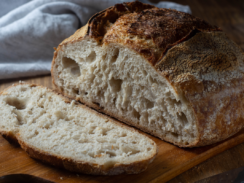
Serve hot with crusty bread and a chilled glass of crisp, earthy white wine that can stand up to the saltiness of baccalà, such as Verdicchio or Frascati.

Baccalà con patate

Posted in Meat, Fish and Legumes, Recipes and Wine Pairings | Tagged , , , , | 8 Comments